Showing posts with label color diamond. Show all posts

Friday, April 16, 2010

The Curse of Hope Diamond

According to legend, the fabulous jewel now known as the Hope diamond once decorated as the eye of an Indian idol of deity Sita, Ever since it was stolen from the Indian temple, it passed through several hands, touching each with its cursed legacy.
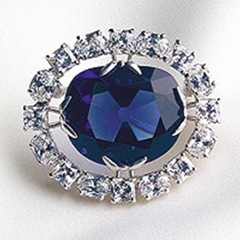
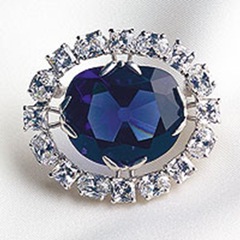
The Hope Diamond

It was in the possession of the French trader and smuggler Jean Baptiste Tavernier. While travelling to Indian, Tavernier was attacked by a pack of wild dogs and torn to pieces.
The gem passed next to France's King Louis XIV, who reduced its staggering size from 112.5 carats to 67.5 and converted it into a heart shaped stone. This reduction, however, did not affect the curse.

After Nicholas Fouquet, a government official who was known for his unruly personality, borrowed the diamond for a state ball, he was convicted of stealing and sentence to life in prison, where he died.

Princess de Lambelle, who wore the diamond regularly, was beaten to death by a Parisian mob. The king himself died broke and scorned his empire in ruins.

Louis XVI and his queen Marie Antoinette were beheaded during the French Revolution of 1789, when the stone was inherited by him.

During 1800, it was reshaped by the Dutch jeweler Wilhelm Fals. He died of sheer grief when the diamond was stolen by his son Hendrick, who went on to commit suicide under the cursed influence of the diamond.

In 1830, it was purchased by London banker Henry Thomas Hope for $150,000. It proved a mixed blessing. Family fortunes declined rapidly, and one grandson died penniless before another heir finally sold the stone. Over the next 16 years, the Hope diamond went from owner to owner, including Frenchman Jacques Colet, who committed suicide, and Russian Prince Ivan Kannitovitsky, a murder victim. In 1908, Turkish Sultan Abdul Hamid paid $400,000 for the diamond and promptly bestowed in on his favorite concubine, Surbaya. But within a year Hamid had stabbed Subaya to death and had been dethroned himself.

Simon Montharides had it next until one evening his carriage overturned, killing him, along with his wife and infant daughter.

Diamond and accompanying curse next made their way to American financial tycoon Ned McLean, who paid the bargain price of $154,000. Vincent, his son, soon succumbed in a car crash, and a daughter died from a drug overdoes. McLean's wife became addicted to morphine, and Mclean himself died in an insane asylum. Mrs. McLean passed away in 1947, leaving the hazardous stone to six grandchildren. One of the six McLean grandchildren was found dead of unapparent cause in her Dallas apartment on December 13, 1967, at the age of twenty-five.

The McLean family sold the diamond to Harry Winston, a dealer in precious stones. Winston, in turn, donated it to the Smithsonian Institution, to get rid of the curse.

It is said that the curse of the Hope Diamond was so strong that when it was delivered to the museum in a plain brown box by the USPS mail carrier James Todd, he faced leg injuries run over by a truck. Further tragedies unfolded on Todd as his wife died of a cardiac arrest, his dog died strangled by its leash and finally his house was burnt down by a fire.

May Yohe, the actor who is supposedly the last of the Hopes; tried to build on the cursed legend of the Hope Diamond by creating a 15-episode serial – “The Hope Diamond Mystery”. Although her efforts to hog limelight through the Hope Diamond did not bear fruit, the fact remains that the Hope Diamond has at its wake the tragedy of many non-famous jewelers and intermediaries who were somehow involved in its handling.
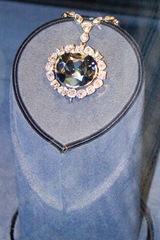
hope_diamond 


The 45 carat blue diamond displayed at the Museum.


Currently, displayed in the Smithsonian Natural History Museum in Washington, D.C. Perhaps the curse can't work its misery on institutions the way it did on individuals.
Technorati Tags:

Monday, April 12, 2010

COLORED DIAMOND GRADING SYSTEM

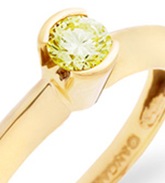
The fancy-color diamonds are blue, yellow, or pink colored. While a colorless diamond is valued for their lack of color, the fancy-color diamond is valued for the intensity of their color. The intensity of color is described by nomenclature used by international diamond grading authority (e.g. GIA and IGI) for colors that are not in the normal color range of Diamonds. These color grading system are similar to color grading system used for the colored gemstones like ruby, sapphire and emerald. The diamond grading authorities are internationally recognized laboratories that use a list of 27 color hues, the tone and saturation of these hues are then described with one of nine descriptors.

I8k-Yellow-Gold-Fancy-Colored-Diamond-Ring-(1By4-ct_-tw_)_ARY0362_Reg

  • Faint
  • Very Faint
  • Light
  • Fancy Light
  • Fancy
  • Fancy Dark
  • Fancy Intense
  • Fancy Deep
  • Fancy Vivid
Technorati Tags:

Friday, April 9, 2010

The Noor-ol-ain Diamond

Introduction

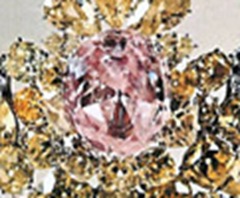
Noor-ol-Ain is the second largest historic oval pink diamond that dates back to the Mughal dynasty. It is the sister stone of Darya-ye-noor diamond.

The History of Jewellery

History of the stone & Meaning of the stone’s name

Noor-ol-Ain is a persian word meanings the light of the eye. It is one of the largest pink diamonds in the world and is believed to have once formed part of an even larger gem. The Noor-ol-ain Diamond is believed to be a portion of the fabled Great Table Diamond. The fabled great Table Diamond had also been described in the journal of the French jeweller Jean-Baptiste Tavernier in 1642, who called it the "Diamanta Grande Table".The fabled great Table Diamond was cut to form Darya-ye-noor Diamond and a smaller part called Noor-ol-ain Diamond. It was in possession of the Mughal emperors. In 1739, Nader Shah of Persia invaded Northern India, and as payment for returning the crown of India to the Mughal emperor, Muhammad, he took possession of the entire fabled treasury of the Mughals, including the Darya-ye-noor, Noor-ol-ain, the Koh-i-noor and the Peacock throne. All of these treasures were carried to Iran by Nader Shah and both of these pieces, Darya-ye-noor, Noor-ol-ain, are currently part of the Iranian Crown Jewels.

Characteristics of Diamond

Noor-ol-Ain diamond is a pale pink second largest diamond weighing around 60 carats (12 g), oval in shape.

Noor-ol-ain Diamond is Type IIa diamonds. These diamonds are almost or entirely devoid of impurities, and consequently are usually colorless, have the highest thermal conductivity as well as are very transparent in ultraviolet. Usually Type IIa diamonds have imperfections that impart yellow, brown, orange, pink, red, or purple color to the gem.

Technorati Tags:

Thursday, April 8, 2010

Top 10 List of Famous Pink Diamonds

S/N

Name

Carat Weight

Color

1

Darya-ye Noor

182

Pale pink

2

Noor-ol-Ain Diamond

60

Pale pink

3

Steinmetz Pink Diamond

59.60

Vivid pink

4

Shah Jahan Diamond

56.71

Light pink

5

Agra Diamond

32.34

Fancy light pink

6

Pink Sunrise Diamond

29.79

Light pink

7

Rose of Dubai Diamond

25.02

Light pink

8

The Mouawad Lilac Diamond

24.44

Fancy purplish pink

9

The Williamson Diamond

23.56

Light pink

10

The Graff Pink Orchid Diamond

22.84

Fancy purplish pink


Technorati Tags:

Wednesday, April 7, 2010

The Hope Diamond

Introduction

“The French Blue” or “The Hope Diamond” or “Tavernier Blue “is large fancy dark grayish blue diamond. “The Hope Diamond” is famous for supposedly being cursed and is currently housed in the Smithsonian Natural History Museum in Washington, D.C.

The Hope Diamond

History of the stone & Origin of the stone’s name

The Hope Diamond is the previous record holder for being the largest faceted diamond and is probably the most well known and historically interesting of all diamonds. The Hope Diamond was originally known as the “Tavernier Blue” named after its first owner which was a crudely cut triangular diamond. According to legend, it was stolen from an Indian temple from statue of goddess Sita where it formed the eye. It purchased by Jean-Baptiste Tavernier around 1660. The diamond was sold to King Louis XIV of France who had it cut into a 67.125 carat stone. It was renamed “the French Blue” and worn for ceremonial functions in France. The diamond was rarely seen until Louis XVI gave it to Marie Antoinette who added it to her jewelry collection. When the French Revolution started the diamond was stolen and resurfaced in La Havre four years later. The diamond disappeared for another 20 years; when it resurfaced in the hands of a London diamond merchant Daniel Eliason in 1812. Henry Philip Hope purchased the diamond in 1824, after his death his heirs fought over the diamond. It passed through three generations of the Hope family until Henry Francis Hope Pelham-Clinton Hope fell into bankruptcy and was forced to sell the stone. The diamond continued to change hands until Pierre Cartier acquired it in 1910. Cartier reset the stone and sold it to socialite Evelyn Walsh McLean she was fascinated by the magical stone “The Hope diamond” the largest and most perfect blue diamond in existence and she thought things that were unlucky for everybody else would be lucky for her, because she was an exception. The deal closed at $180,000.She left the stone to her heirs; however it had to be sold again to settle outstanding debt. The stone was purchased by legendary jeweler Harry Winston who had the lower portion of the stone cut to increase its brilliance. After having the diamond as part of his traveling exhibit known as "the court of jewels," he donated it to the Smithsonian Institution where he sent it through the US postal service in plain brown wrapper. The diamond is said to have been cursed by the Hindu temple priest because financial ruin or sudden death occurred to many who owned it. The diamond was also the inspiration for the fictional "Heart of the Ocean" in the movie Titanic. In 2005 new computer research proved that the Hope Diamond was indeed the French Blue that was stolen from the jewelry collection of Marie Antoinette. The currently the stone is priced at $350 Million and more.

Characteristics of Diamond

“The French Blue” or “The Hope Diamond” or “Tavernier Blue “is fancy dark grayish blue diamond weighing 45.52 carats (9.10 g).The Hope Diamond is deep-blue to the naked eye because of trace amounts of boron within its crystal structure, but it exhibits red phosphorescence under ultraviolet light. It is classified as a Type IIb diamond, a Type IIb means free of nitrogen, but contains trace quantities of another impurity, boron, which imparts a blue color to the diamonds. All the natural blue diamond belongs to this group. However they are extremely scarce, constituting less than 0.1 % of all natural diamonds.

Technorati Tags:

The Heart of Eternity

Introduction

"The Heart of Eternity" is the 6th largest blue diamond in the world. It is the rarest fancy blue diamond belonging to the category of the famous blue diamond of the world.

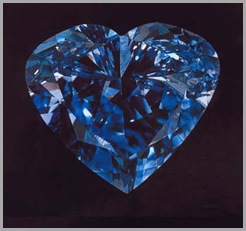
The heart of eternity diamond

History of the stone

"The Heart of Eternity" diamond originated in the Premier diamond mines of South Africa, the only major source of blue diamonds in the world today. The diamond originated in the 1990s.The heart of eternity is the sister stone of the Millennium Star which were both cut from the same stone. . The diamond was purchased by the Steinmetz Group. The master cutters of the Steinmetz Group headed by Nir Livant transformed the rough diamond into a perfect heart-shaped diamond weighing 27.64 carats. They worked round the clock for more than three years, cutting and polishing the diamonds, in order to get them ready for the ceremonial unveiling just before the onset of the new millennium. It formed the part of the rare collection of diamonds known as the DeBeers Millennium Jewels Collection. The Heart of Eternity", was unveiled to the world, at an impressive ceremony held in October 1999, at the headquarters of the Central Selling Organization in London, with top officials of the De Beers Company and the Steinmetz Group in attendance.

Origin of the stone’s name

"The Heart of Eternity" is the name given by the Steinmetz Group, to the 27.64-carat, rare blue diamond, cut in the form of a heart shape, by the master cutters of the Group headed by Nir Livant, and unveiled to the world, together with ten other blue diamonds and the Millennium Star, on the eve of the new Millennium and exhibited throughout the year 2000 at the Millennium Dome in London. The name seems to reflect not only the beautiful heart shape of the diamond, but also the eternal character of diamonds that have lasted for almost 3-4 billion years, and may continue to exist eternally till the end of time.

Characteristics of Diamond

"The Heart of Eternity" diamond is a 27.64-carat, fancy vivid blue diamond with a heart-shaped cut, and a color grading of VS-2. The estimated value of the diamond in the year 2000 was around $ 16 million, but the record-breaking sale of a 6.04-carat internally flawless blue diamond by Sotheby's of Hong Kong in October 2007 for $ 7.98 million, which works out to about $ 1.32 million per carat, shows the recent unprecedented demand for this rare variety of diamond.

Technorati Tags:

Friday, October 24, 2008

How Color Diamonds Get Their Color

color diamond,natural color diamond,loose natural color diamond
I wish my mistakes were as beautiful!

Well, not exactly mistakes but the theory behind the color in colored diamonds does tell us that even impurities can make beautiful diamonds even more tempting. So when Mother Nature blesses a diamond with impurity, it becomes a colored diamond, one of the most beautiful and precious rocks on earth. A nitrogen impurity makes diamonds yellow, boron makes a diamond blue, extreme pressure gives a diamond brown, red, pink and purple hues and natural radiation gives a diamond green tint.

color diamond, pink diamond, pink-purple diamond
Wow! If only extreme pressure in life could make us that beautiful! No, no. This was sincerely about diamonds I do not intend to do philosophy here. I love diamonds and everything about them – material girl… thinking uh?